

Every trekker in the Annapurnas chases the golden hour. Two sunrise viewings dominate conversations along the trail: the famous spectacle from Poon Hill and the profound moment at Annapurna Base Camp. Deciding which is better misses the point. They are entirely different experiences, each powerful in its own right. Understanding that difference shapes how you remember your journey.
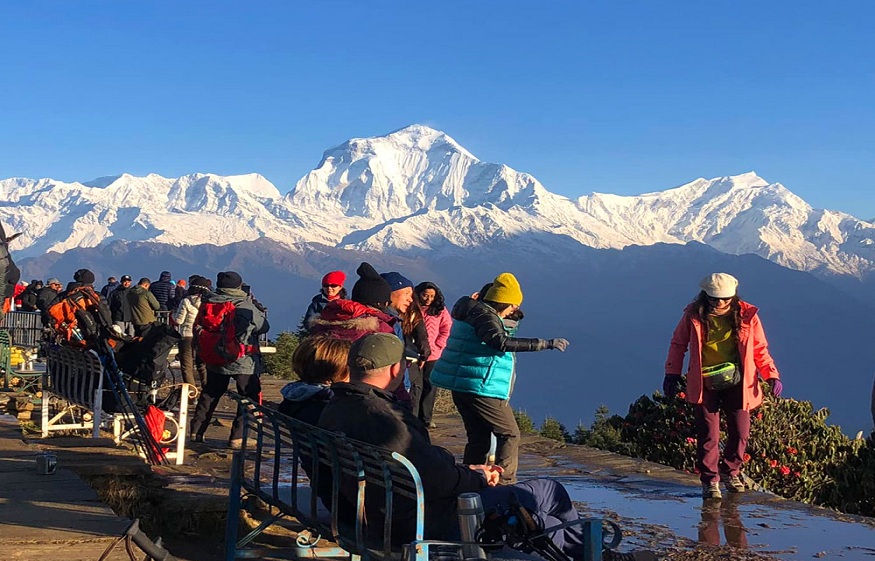
Poon Hill is a grand, theatrical production. It happens relatively early in the trek, usually around day three or four. To reach the viewpoint requires a pre-dawn start, a steep climb in the dark guided by headlamps. You join a pilgrimage of hundreds, all moving silently up the stone steps. There is a shared, chilly anticipation in the crowd.
Reaching the top feels like arriving at a natural amphitheater. A viewing tower and open ridges offer space for everyone. You look out over a sea of lesser peaks, a rolling horizon of dark blue ridges. Then the show begins. First light does not hit one mountain. It ignites an entire panoramic canvas. The entire Dhaulagiri and Annapurna ranges, from fishtail Machapuchare to distant Manaslu, catch fire in a slow, sweeping wave of alpenglow. Cameras click incessantly. It is breathtaking, communal, and undeniably spectacular. You are an audience member witnessing a vast, majestic performance from a chosen balcony.
Sunrise at Annapurna Base Camp is something else entirely. It is not a show you watch. It is a moment you inhabit. Reaching ABC is the culmination of a week’s effort, a slow ascent into the heart of the mountains themselves. You are no longer looking at the skyline. You are surrounded by it. You sleep in a teahouse literally in the shadow of Annapurna I’s south face.
Morning here is a silent, intimate affair. Far fewer people make it to this sanctuary. You stumble from your lodge into a world of greys and blues, your breath fogging in the frozen air. There are no vantage points to claim, just the glacial moraine under your feet. You stand in the center of the circle.
Light here does not sweep across a panorama. It emerges. The sun finds a narrow gap between peaks and pours directly into the basin. It does not color distant summits first. Instead, it illuminates the ice of the glacier at your feet, making it sparkle. It climbs the sheer black rock face of Annapurna directly in front of you, turning it a sudden, blinding orange. There is no sound but the wind and your own heartbeat. The experience is immersive, raw, and deeply personal. You are not watching the mountains. You are standing with them.
So which sunrise leaves a more lasting impact? It depends entirely on what moves you.
Poon Hill offers the classic, postcard-perfect Himalayan panorama. Its magic lies in its sheer scale and accessibility. For many, it is their first real glimpse of the high Himalayas, a stunning reward early in the trek. That memory of the first big reveal, seen alongside new friends from the trail, carries a special joy. It is a celebratory, shared moment.
Annapurna Base Camp provides a visceral, emotional payoff. Its power comes from context. You feel the altitude in your lungs. You remember every step it took to get there. The sunrise feels like a personal gift for that effort, a private audience with the giants. It is less about a colorful view and more about a feeling of awe, of being a tiny speck in a colossal, ancient place. The silence is part of the memory.
Smart trekkers do not choose one over the other. They understand that each sunrise serves a different purpose in the story of their hike. Poon Hill is the exciting prologue, the wide eyed introduction to the epic scale waiting ahead. ABC is the profound climax, the quiet, hard earned finale.
For anyone hoping to explore the trek fully, planning for both viewings is essential. They bookend the emotional arc of the entire ABC trek. Missing Poon Hill means missing that thrilling, communal introduction to the Himalayas. Missing the sunrise at Base Camp means skipping the deeply personal culmination of your physical journey. Together, they create a complete narrative. One is the breathtaking overture. The other is the soul-stirring final note. You need both to hear the whole symphony.